Digital Humans
AI Workforce & Virtual Employee Platform
Build a virtual AI employee platform — deploy digital workers across departments with defined responsibilities, approval controls, and performance monitoring.
Digital Humans provides a complete platform plan for building and managing virtual AI employees. Businesses assign digital employees to roles across customer support, sales, marketing, finance, administration, research, operations, and project management. Each virtual employee receives defined responsibilities, permissions, workflows, performance measures, escalation rules, and human approval controls. The platform focuses on structured AI workforce deployment with clear human oversight.
Launch pricing ends August 27, 2026
Introductory pricing — 30 days only. After that, regular price of $499 applies.
Secure payment via Stripe. Instant delivery. Single-business licence.
See how purchase and download works →Purchased products remain available through your PrismBay account. Security-protected email download links expire, while account access continues under the applicable licence terms.
💰 Also available in the Complete AI Business Portfolio
Get NexusOS, Nexus One, Empire AI, Nexus Network, Digital Humans, Genesis Platform, GuardianOS, SpendShield AI, EvidenceFlow AI for $2,699 — save $1,542
View bundles →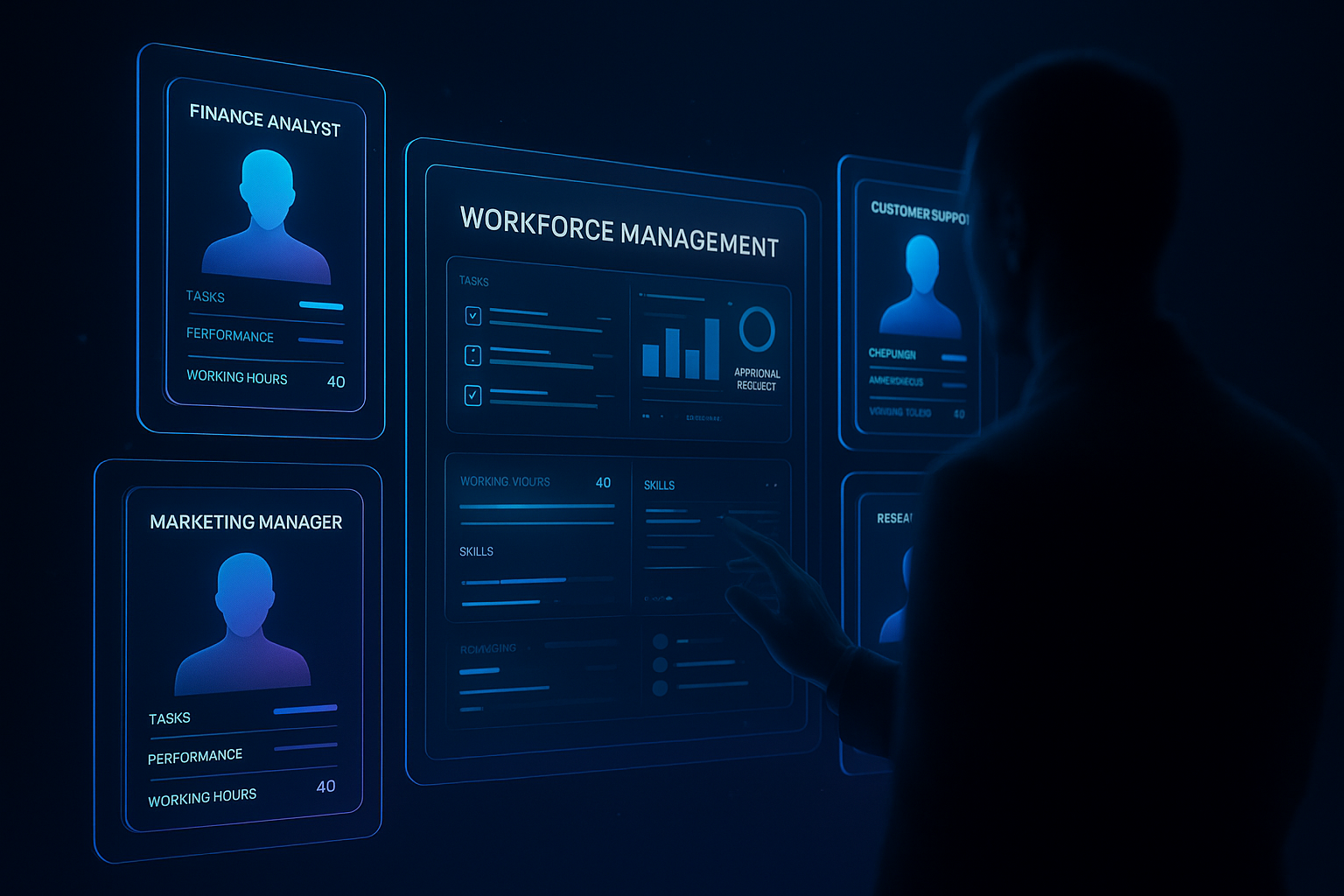
What's Included
Every purchase includes the complete business system blueprint.
Who It's For
Who this blueprint is built for, what you'll need to use it, and what it doesn't include.
Best for
Organizations planning a structured AI workforce — typically operations leads and CTOs — that want to deploy virtual AI employees across customer support, sales, marketing, finance, administration, research, operations, and project management, with defined responsibilities and human approval controls.
What you'll need
An AI-literate technical lead familiar with AI/LLM integration patterns to implement the platform; the workforce-design and governance sections can be handled by a business lead without AI expertise. Access to the workflows and domain data the virtual employees will handle.
What's not included
- No virtual employees included — no working AI workers, agent code, or deployed platform is delivered; the blueprint defines the workforce platform to build.
- No custom build work — the buyer's team builds and operates the platform.
- No underlying AI models or proprietary data — you supply the model access and the business data for each role.
- Human oversight is the buyer's operating responsibility — the blueprint specifies approval controls and escalation rules, but running them is part of the system the buyer builds and manages.
Deep Dive
A closer look at how Digital Humans works in practice, how it is implemented, and its architecture.
Workflow overview
Digital Humans is about managing a structured AI workforce — virtual employees that perform work across customer support, sales, marketing, finance, administration, research, operations, and project management, under defined responsibilities and human oversight. In day-to-day operation, an organization assigns each virtual employee a role drawn from a department role template, giving it defined responsibilities, permissions, and the workflows it is allowed to act on. Work is routed to virtual employees through task assignment workflows, and they execute within their permissions, escalating through defined escalation procedures when they hit a boundary or an edge case. Human approval controls sit at the gates that matter — a virtual employee can prepare and recommend, but actions that carry risk or require judgment route to a person for approval rather than running unattended. Perpetual enforcement is the point: virtual employees don't have discretion beyond their configured scope. A work quality review step samples or audits output, and a performance monitoring framework tracks each employee's metrics so the team sees how its AI workforce is performing. An AI workforce dashboard gives managers a single view of all virtual employees, their tasks, and status. Human oversight is an operating responsibility — the blueprint specifies the approval and escalation controls, but running them is part of the system the buyer builds and manages.
Implementation stages
Digital Humans is built in phases that pair workforce design with platform construction. In the planning stage, a business lead without AI expertise designs the workforce — deciding which departments get virtual employees, defining role templates, responsibilities, permissions, and the approval and escalation rules — while an AI-literate technical lead maps the AI/LLM integration patterns the platform will need. The build stage implements the virtual employee platform: digital employee profiles, department role templates, task assignment workflows, human approval controls, employee permissions, escalation procedures, work quality review, the AI workforce dashboard, and the performance monitoring framework. During rollout, the workforce is deployed a role at a time, starting with the lowest-risk role where both the workflow and the approval gates can be validated before expanding to more consequential roles across departments. The operate stage is the long-term running cycle: virtual employees execute assignments under oversight, human approvers work the queues, performance monitoring flags underperforming or misbehaving employees, and leadership rebalances the department allocation model as the workforce scales. No implementation timeline is assigned; pacing depends on how many roles and departments are deployed and the maturity of the workflows being automated.
Architecture overview
Digital Humans' architecture is a virtual-workforce platform specified in blueprint form, organized around the concept of a virtual employee platform model that hosts individual AI workers. Each virtual employee is defined by a digital employee profile and a department role template that fixes its responsibilities, permissions, and allowed workflows — the governance that keeps AI workers in scope. Task assignment workflows route work to the right virtual employees, and employee permissions enforce what each can access and act on. Human approval controls create gates where risky or judgment-heavy actions must be approved by a person, and the AI workforce draws on underlying AI/LLM access the buyer arranges. Escalation procedures define how virtual employees hand off work they cannot resolve. Work quality review samples or audits output, a performance monitoring framework tracks per-employee metrics, and an AI workforce dashboard gives a consolidated operational view. A department allocation model guides how many virtual employees serve each function, and the blueprint specifies a subscription pricing structure. No virtual employees, agent code, or deployed platform are delivered — the blueprint defines the workforce platform to build, and the buyer supplies the model access and business data for each role.
Frequently Asked Questions
Compare Products
See how Digital Humans stacks up against similar products.